
EC Rates, Root Health & Nutrient Uptake: How Excess EC Impacts Root Function
Electrical conductivity (EC) is a key indicator used in greenhouse production to assess soluble salt levels in irrigation water and growing media. While EC is often associated with fertilizer concentration, its influence extends further — directly affecting root function, water uptake, and nutrient availability.
For professional growers, understanding how EC behaves in the root zone — and how both high and low EC conditions impact root health — is essential for maintaining consistent crop performance.
What EC Measures and What It Does Not
EC measures the concentration of dissolved soluble salts in a solution. In greenhouse systems, these salts primarily come from fertilizers, but may also originate from source water, growing media components, and residual nutrients.
EC does not measure individual nutrients or nutrient balance. Instead, it provides an overall indication of salt concentration. Because different ions contribute differently to EC, tracking changes and trends over time is often more useful than relying on a single reading.
How EC Influences Root Health
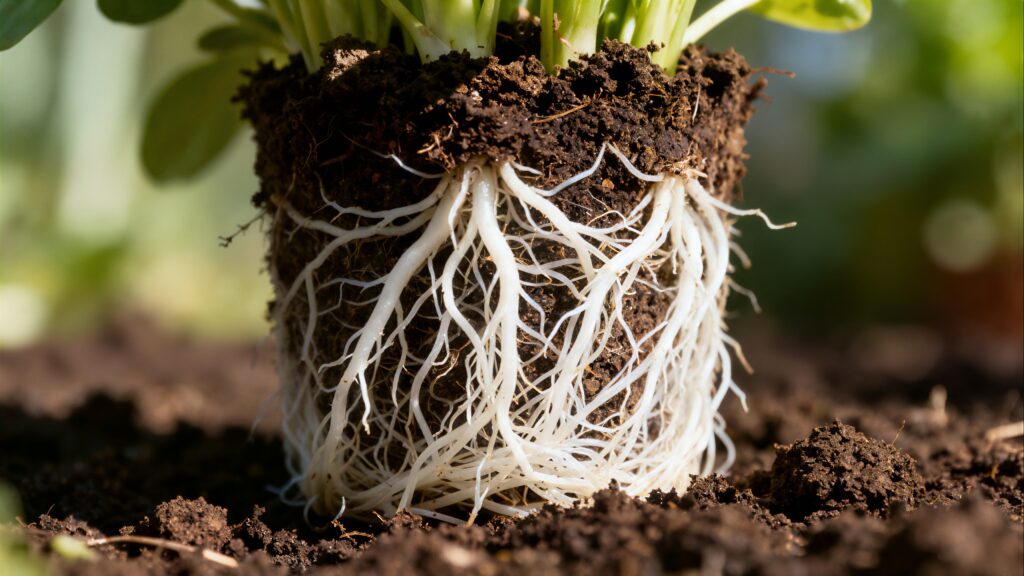
Roots are directly exposed to EC conditions in the growing medium, making them the first part of the plant affected by changes in soluble salt levels.
High EC Conditions
When EC levels remain elevated, soluble salts increase osmotic pressure in the root zone. This makes it more difficult for roots to absorb water, even when adequate moisture is present.
High EC can:
- Reduce water uptake
- Damage fine roots and root hairs
- Limit root growth and function
- Increase stress that may predispose roots to disease
Root damage from excess EC often occurs before visible symptoms appear above the crop, which is why EC-related issues can be misdiagnosed later in production.

Low EC Conditions
Low EC indicates limited nutrient availability in the root zone. While low EC reduces the risk of salt stress, prolonged low EC can restrict nutrient uptake and root development.
Low EC may result in:
- Reduced nutrient availability
- Slower growth
Both extremes can negatively impact root performance and nutrient uptake.
EC and Nutrient Uptake Efficiency
Nutrient uptake depends on both nutrient availability and the plant’s ability to absorb water through the root system.
- High EC restricts water movement into roots, limiting nutrient uptake even when nutrients are present.
- Low EC indicates insufficient nutrient supply to support uptake.
In systems where fertilizer inputs remain consistent, EC in the root zone can still change over time due to plant uptake patterns, irrigation practices, and accumulation of salts. Monitoring EC helps assess whether nutrients are accessible to roots — not just whether they have been applied.
Where EC Should Be Measured
Effective EC management requires regular monitoring at multiple points:
- Source water — establishes baseline soluble salt levels
- Fertilized irrigation water — confirms fertilizer delivery accuracy
- Root zone / growing medium — reflects conditions experienced by roots
Common measurement methods include saturated media extract (SME), 1:2 dilution, and leachate pour-through. Because each method produces different values, results should always be interpreted using guidelines specific to the chosen method.
Consistency in sampling method and timing is critical for meaningful interpretation.
Using EC as a Management Tool
EC is most useful when viewed as a decision-support tool rather than a standalone target value. Monitoring trends over time allows growers to identify developing issues early and make adjustments before root stress impacts crop performance.
By understanding how EC affects root function — and recognizing that root stress often precedes visible crop symptoms — professional growers can manage fertility programs with greater precision.
To discuss EC management and fertility considerations within your production system, connect with your Plant-Prod distributor.